Recently, the Fast funded account prop firm segment has opened up several doors for traders who want to leverage bigger funds without putting in large chunks of their own capital. These prop firms give users the chance to demonstrate their trading capabilities either through a series of challenges or via a real-time funding model.
Besides the profit potential, funded trading has a substantial element of risk control, discipline, and constant performance evaluation embedded in it. A lot of traders lose out on their chances as they tend to overtrade, disregard their stop loss orders, or fall prey to emotional trading when under stress.
As a result, a whole range of traders start to wonder what exactly is swing trading and why it is one of the most powerful trading methods when it comes to funded trading.
Swing trading is a kind of trading strategy that allows traders to pause and step back a little, look for trade setups of the highest quality, and handle risks more proficiently at a Fast funded account prop firm.
DEFINITION OF SWING TRADING
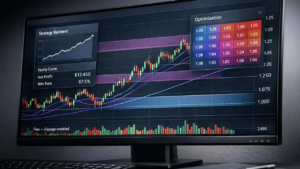
What is swing trading? It is among the several questions that new traders ask when they are beginning to trade forex or prop firm.
Swing trading is a form of trading where traders carry on with their positions for a number of days or even weeks to take advantage of the medium-term price movements of the market.
Instead of swinging from one reaction to another at every market move, swing traders only look at the higher timeframe charts and their setups that they can pin down as structured and reliable ones.
The chief intention is to run with the general trend of the market and at the same time, get rid of the emotional decisions that come about as a result of the constant lower timeframe movements.
This results in an approach that is both more relaxed and disciplined.
REASONS FOR SWING TRADING TO BE THE RIGHT MATCH FOR FUNDED TRADING
One of the ways in which a Fast funded account prop firm challenge might be structured is to see whether traders can not only preserve the capital but also perform on a consistent basis over a period of time.
By its very nature, swing trading is a great kind of trading that can be used to meet the above objectives because it is a kind of trading that promotes the virtues of patience and well-thought-out trade execution.
Compared to running the trade aggressively and going for scalping, swing trading is all about a limited number of trading opportunities but of the highest quality. This way, it does not only cut down on the total time spent in the market but also avoids getting one’s emotions into the trade.
Traders who get what is swing trading also have an aha moment when they see that, in keeping to consistency, what they trade is far more important than how fast they make their profits in a funded setting.
SWING TRADING AND RISK MANAGEMENT: A PERFECT PAIR
Arguably, the biggest factor that leads to a trader getting successfully through a Fast funded account prop firm evaluation is the trader’s risk management skills.
One of the chief benefits that come with swing trading is that the trader gets the chance to carefully prepare the whole trade, from entry to take-profit and stop-loss levels.
Most of the time, swing traders mark their entry points, stop losses, and profit targets with the utmost precision prior to going into the market.
With such a working plan in hand, a trader is far less likely to get emotionally carried away and end up violating the drawdown limits imposed by the prop firms.
So, what is swing trading without risk management anyway? It is just a kind of emotional gambling rather than a method of professional trading.
HIGHER TIMEFRAME ANALYSIS
Market prices often move erratically in lower timeframes but by moving to a higher timeframe such as a 4-hour chart or a daily chart, these random price movements are minimized and the overall direction of the market becomes more apparent.
As a swing trader, you can time your entries better by using these trimmed higher timeframe fluctuations and so your decisions will be less of a gamble and more based on the market’s underlying strength.
Also, swing traders become more patient and less reactive which together is a great help during drawdowns when it can be very tempting to throw in the towel.
POSITION SIZING AND CAPITAL PROTECTION
Proper capital management is often underestimated but is vital for funded trading to be a success.
If your funding challenge motive is to go all in and get it done quickly, you may have to do it several times over or your account will be wiped out.
Consistent swing traders who limit their potential losses per trade tend not only to have a smoother equity curve but also less stress related to the drawdown and therefore better decision making.
STOP LOSSES AND STRUCTURED EXECUTION
Stop losses protect your capital and limit the potential of big losses.
Each transaction involves deciding the maximum loss you are willing to accept if your hypothesis is proven wrong.
This strategy helps to prevent emotional reactions in fast market movements and also safeguards your account balance from unforeseen big losses.
Long term trading success requires disciplined stop loss use in any prop firm scenario
Without stop losses, you are open to significant emotional and financial damage.
HOW SWING TRADING REDUCES OVERTRADING
One of the main reasons for failure in funded evaluations is overtrading.
Most traders are so caught up with the idea of making a quick buck that they keep on trading one after another hoping to get to their target faster and inevitably they blow their accounts.
The swing trading is a good antidote to this as it is completely impossible to develop too many setups in one minute or one hour timeframe reasoning, hence reducing the trading frequency.
EMOTIONAL CONTROL AND DISCIPLINE
Psychological readiness is a very big part of the funded trading process.
If you ask people with successful trading systems why their results are inconsistent, most of them will point to the fact that they let their emotions get the better of them after losing or winning trades.
The reasoning behind swing trading as a way to deal with emotional stress is that traders don’t always have to hear every beep and feel every twitch of the market, they also get the luxury of taking the market from a distance from time to time.
This slower rhythm provides more logical thinking and honing of better discipline.
COMMON MISTAKES BEGINNERS MAKE
The number one rookie mistake is to confuse swing trading with just holding on to a lost trade because emotionally it is hard to give up on it.
Another pitfall is the combination of swing trading with erratic impulsive lower timeframe trading which results in loss of consistency.
There are also some who overtrade leverage-wise looking for the fast profit during evaluation process.
Such behavior in a Fast funded account situation within a prop firm usually results in drawdown violations and blown accounts.
WHY PROP FIRMS VALUE CONSISTENCY
Most Fast funded account prop firms are definitely not interested in finding traders who will roll the dice only for the sake of trying to win big and fast.
Instead, the prop firm is looking for steady performers who on top of that are capable of managing their risk almost to perfection.
Being a swing trader is one of those very few paths to embody these traits as it by nature requires the practice of patience, discipline, and a well thought-out plan.
Staying funded is a matter of consistency.
CONCLUSION
Knowledge of what is swing trading allows a trader to evolve a step further into coupled with the discipline and attitude required for trading in the funded account environment.
In a Fast funded account prop firm environment, the use of swing trading significantly contributes to a well-designed risk management procedure by cutting out excessive trading, lending a hand to emotional regulation, and leading the way to methodical execution.
Relying on higher timeframe analysis, exercising patience, and safeguarding the capital are the three principal areas that when done right can help traders to not only pass evaluations but also to successfully maintain funded accounts.
Only those traders relying on consistency and discipline rather than on the emotional side of the market and approaching it on a short-term basis will come to a realization of long-term funded trading success.